Semi-Final Sunday: A Quick Analysis of Both 2026 World Junior Semi-Final Matchups
When looking at recent world junior history, Finland-Sweden and Canada-Czechia might be the two most exciting matchups we could’ve gotten at this year’s tournament. The rivalry between the Finns and the Swedes is one all fans should be familiar with, and it typically provides must-watch hockey at any level. But the recent battles between the Czechs and Canadians have been major tournament storylines for several years now, causing it to brew into the most relevant world junior rivalry. Two highly anticipated games, and neither disappointed. So I wanted to dive into what stood out from an exciting World Junior Sunday, and what ultimately sent Sweden and Czechia to fight for a gold medal.
Finland – Sweden
It feels impossible that we’ll get a meeting between these two nations that won’t provide endlessly entertaining hockey. It doesn’t matter what level, and it certainly doesn’t matter who’s favored, every game between the Finns and Swedes is must watch hockey for all fans of the sport, and Sunday evening was just more reassurance why.
There’s no doubt Sweden came in as favorites in this one, they’ve got far more star power with the likes of Anton Frondell, Viktor Eklund, and Ivar Stenberg, and they cruised through the group stage, which included a convincing win over the Americans on New Year’s Eve. But as I already mentioned, none of that seems to matter in this rivalry.
I thought it was Finland who got off to the better start in this one. Despite surrendering the first goal of the game just thirty six seconds in (which I’ll talk more about later), Finland was able to suppress the Swedish attack quite effectively and found a way to equalize before the period ended. The first twenty minutes is exactly how Finland tends to play these big games. They kept things relatively low-event, and found the back of the net in the dying minutes off some sustained o-zone time. Although the game started just how the Fins would have liked, the second period saw Sweden open things up a bit more, as their pack of star forwards were able to generate more consistent offensive looks. Scoring twice in the period, Sweden took a 3-2 lead into the third, and it looked like their talent advantage might be too much for Finland to overcome. However, in typical Finnish fashion, they scored the equalizer with just six minutes to go in regulation to force overtime.
For me, a standout from the first sixty minutes was the oddity that some of the goals were scored with. From the very first shot of the game, which was a whiffed glove stop by Petteri Rimpinen on an outside wrister, there was a tone that this game might feature some unique moments, and that was exactly the case. Both sides would add another goal in an uncommon manner, and with play for most of the game being heavily defensive, it seemed like the only way either team could find the back of the net. Although both sides benefitted from this puck-luck at some point, It seemed like more of a slap in the face to the Finns, who were doing an effective job defending throughout most of the game. Two of Sweden’s three goals coming on odd bounces should be a focal point of the conversation around this game. I’m not saying they deserved to lose because of it, but It’s hard to ignore how it affects such a close hockey game.
Bounces aside, this was a fantastic hockey game, which is usually the case when these nations meet. But this time around, I think the difference was a Sweden team that simply had too much star power for Finland to overcome. Linus Eriksson and Ivar Stenberg, who have both been fantastic all tournament, were able to find the back of the net in this semi-final, while Anton Frondell and Viktor Eklund saw their names on the scoresheet as well. Frondell’s shootout winner secured the Sweden victory and will give an absolutely loaded forward group a chance to bring home the country’s first world junior gold since 2012.
It’s impressive how well this Finnish team battled despite having the noticeably weaker roster. In the back half of the third period, there should have been no doubt that Finland would find a way to tie this game, it’s what they do, and with a powerplay (and an Aaron Kiviharju crossbar) at the end of overtime, this game was so close to ending in the opposite fashion. Nonetheless, this semi-final Sunday gave us fans yet another instalment of one of the most exciting and consistent rivalries our sport has to offer.
Canada – Czechia
While Finland-Sweden is a rivalry most hockey fans know well, the brewing hatred between Canada and Czechia is something that’s becoming too prominent to ignore. Sunday night gave us the fourth consecutive meeting between the Canadians and the Czechs in the medal round, and for the fourth consecutive meeting they delivered an intense, dramatic, game.
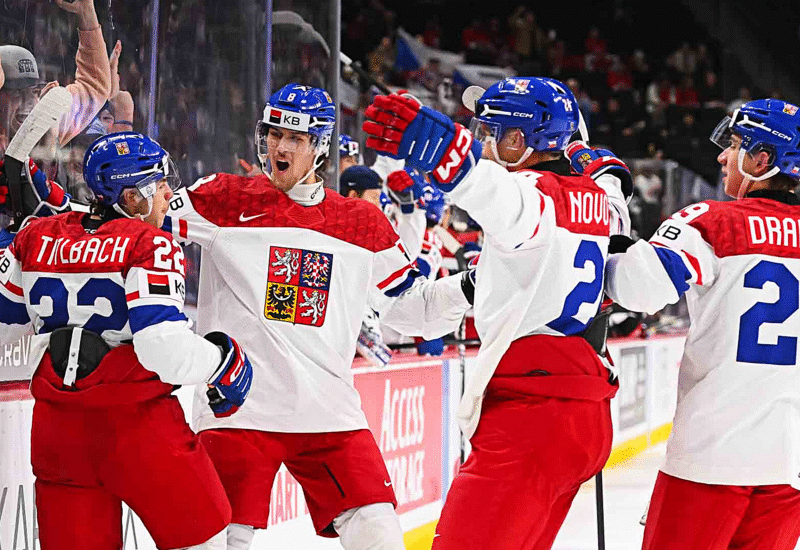
I thought the biggest story from this game was quite simple: Czechia was able to make the Canadian skaters incredibly uncomfortable with constant pressure on the puck. Their defenders were aggressive in the neutral zone, which allowed them to limit effective zone entries and create dangerous turnovers, and their forwards did a fantastic job exploiting Canada’s poor play in their defensive zone through their cycles and board play. The Czechs were by far the more comfortable team in this hockey game, and I believe their first and third goals provide a great example of it. On the first, Braedon Cootes was the victim of forechecking pressure as he attempted to regroup behind his own net, which caused him to force a poor pass along the boards which was easily jumped and led directly to the puck ending up in the Canadian net. On the third Czech goal it was Ethan Mackenzie who tried to force a pass in the neutral zone, which was jumped by an aggressive Czech stick and created an odd man rush the other way. Both goals were key examples of how Czechia’s puck pressure and aggression created back breaking turnovers for Canada and ultimately won them this hockey game.
From a Canadian perspective, it’s an incredibly disappointing result. This is a team I felt was one of their strongest in recent years and had the most dangerous potential of any team in the tournament. In a way, they did live up to that potential, scoring a tournament best forty two goals and featuring the event’s top three individual scorers (Michael Hage, Gavin McKenna, Zayne Parekh). In the end, It was their play in the defensive zone that cost them a chance at a gold medal. They were poorly structured and had trouble breaking out against aggressive forecheckers; it felt like their only way to win was in a high scoring affair that relied heavily on their skill up front and deadly powerplay. It’s sad to see a team with this kind of offensive talent not have a shot at the gold medal, but Czechia deserved to win this game in almost every facet, and for a third straight year, a late Czech dagger is sending the Canadians home without a shot at the gold.
When summarizing this tournament, I think the two most complete teams will compete for glory Monday night, in what should be an extremely passionate game between a pair of nations that are starved for a World Junior gold.

Ethan Alexander
Related Posts
 Team/Player Analysis
 What We’ve All Been Waiting For: 5 Storylines For a Canada vs USA Gold Medal Showdown
 Team/Player Analysis

No Comment